An ADA unit is the right call any time the public is invited — a wedding at a Locust Point venue, a church festival, a Patterson Park 5K, a block party in Highlandtown, a community meeting under a tent. General ADA…
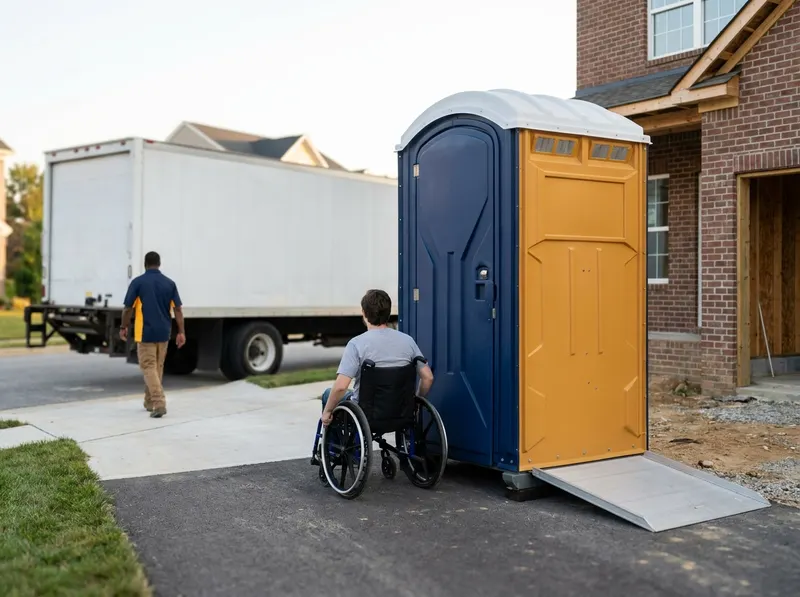
An ADA unit is the right call any time the public is invited — a wedding at a Locust Point venue, a church festival, a Patterson Park 5K, a block party in Highlandtown, a community meeting under a tent. General ADA guidance for temporary event facilities points to at least one accessible unit, and roughly 5% of the total bank once you're running multiple stalls, with the accessible unit on the same firm, level route people already use to reach the rest of the site. On job sites the driver is usually different: a super orders an accessible unit because a crew member needs it or because a general contractor's site rules call for one. Either way, the accessible unit should never be the one parked at the far end of a gravel lot — the path to the door matters as much as the door.
The trade-off against a standard unit is footprint and price, not comfort. A standard portable toilet slips into a parking pad or between a dumpster and a fence. An accessible unit needs a clear five-by-five pad plus door swing and an approach with no curb lip, no cobblestone, no soft mulch. That's a real constraint in Baltimore. Fells Point's cobbles near Thames Street, the brick sidewalks and steep pitch off Federal Hill, and the narrow rowhouse alleys in Canton, Remington, and Hampden all limit where a wide unit can sit level. Blacktop, a flat sidewalk apron, a driveway, or plywood laid over turf all work. Tell us the surface and the approach when you call and we'll place it once, correctly, instead of dragging it twice.
Placement in the public right-of-way is a city matter here — Baltimore is an independent city, not part of Baltimore County, so sidewalk, street, or park permissions go through Baltimore City offices and any park or venue permit conditions, not a county office. Larger open-space sites like Druid Hill Park, the lots around Camden Yards and M&T Bank Stadium, the ground near Fort McHenry, and the medical district blocks by the Johns Hopkins East Baltimore campus each have their own access hours and staging rules. We'll work inside them, and we'll tell you plainly if a spot you picked won't hold a unit that size.
On the two things that go wrong most often with portable restrooms: service frequency is written into your quote, not improvised, so an accessible unit at a two-day festival can be scheduled for an overnight or mid-event visit rather than sitting untouched. And if your date slides, your rental runs long, or you need a second unit added late, call and we'll adjust it — extra time and extra units are priced the same way as the original order, with the total confirmed before we roll. We answer the phone locally, place the unit ourselves, and service what we drop. That's the whole promise: nobody notices the restroom.
Every job gets a firm, written price after a free on-site visit.
Tell us about your ada-accessible portable toilet rental job in Baltimore and we'll send a clear, written quote — usually the same day.
 FiveStar Restrooms Solutions