A handwash station is the right call whenever water actually matters. Temporary food booths are the clearest case — Baltimore City health inspectors reviewing temporary food service setups expect a dedicated…
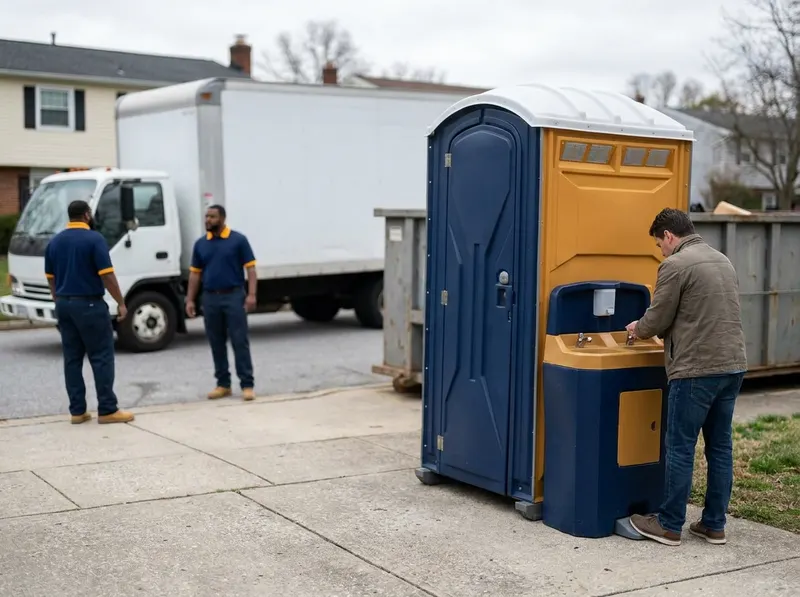
A handwash station is the right call whenever water actually matters. Temporary food booths are the clearest case — Baltimore City health inspectors reviewing temporary food service setups expect a dedicated handwashing facility at the booth, not a bottle of gel, so confirm the exact requirement with the city permit office and then match it with a real sink. Crews sanding drywall in a Charles Village rowhouse, mulch and masonry work around Patterson Park, and food handling at a Hampden block party all fall in the same category. If your need is lighter — office trailer, small crew, guests in dress clothes at a Federal Hill backyard event — the sanitizer dispenser mounted inside a portable restroom, or a standalone sanitizer stand, is usually enough and costs less. The trade-off is straightforward: sinks require water, refills, and grey water pumpout; sanitizer requires none of that but does not satisfy a handwashing requirement.
Baltimore's access quirks decide where a station can actually sit. Fells Point's cobblestones and the tight rowhouse service alleys behind Canton and Highlandtown mean the truck often parks on the street and we walk the unit in by hand — so we ask about gate widths, step counts, and stair landings before the truck is loaded, not after it arrives. Mount Washington's steep driveways need a level pad or the tanks won't drain right. Curtis Bay and Locust Point industrial yards usually have room for a station beside the restroom bank, and sites near the Johns Hopkins East Baltimore campus often need staged placement so the station clears a pedestrian route. Baltimore City is an independent jurisdiction, not part of Baltimore County, so right-of-way and permit rules on a Remington sidewalk placement come from the city — worth checking early if the only spot is public pavement.
Winter changes the answer. Fresh water tanks and foot pumps can freeze during a hard Baltimore cold snap in January and February, which is why many December-to-March jobs run a sanitizer stand or an interior-tank restroom unit instead of an open-air sink, then switch back in spring. From April through the fall festival stretch, the sink is the workhorse: high-traffic events go through soap and towels faster than most planners expect, so we set service frequency around your headcount rather than a default weekly stop.
On the honest-pricing side, delivery, pickup, water fill, soap, towels, and scheduled service are all quoted up front as one figure. Rentals extend and units get added — a food vendor confirms late, a punch list stretches another two weeks — and both are handled with a call, not a renegotiation. Every price here is a ballpark; the exact number is confirmed on a free on-site visit or a short call about your access and dates. Same people quoting it, same people delivering it. Nobody notices the restroom, and nobody should notice the sink either — it should just have water, soap, and towels every single time someone reaches for it.
Every job gets a firm, written price after a free on-site visit.
Tell us about your handwash station rental job in Baltimore and we'll send a clear, written quote — usually the same day.
 FiveStar Restrooms Solutions